When the AQI climbs past 150 and the sky turns that familiar amber-orange, a lot of people reach for their air purifier and assume they're covered. Sometimes they are. Often they're not — because even a well-rated unit can't keep up when smoke is actively infiltrating through gaps, open dampers, and recirculating HVAC systems. Getting your indoor air genuinely clean during wildfire season requires a layered approach, and this guide walks through all of it.
I've run multiple purifiers through two smoke seasons in Oakland, where summer haze has gone from occasional to expected. What follows is the practical strategy I've refined over those years — combined with the best guidance from indoor air quality research and feedback from readers who've done the same.
Step one: Stop the smoke from getting in
Seal your envelope first
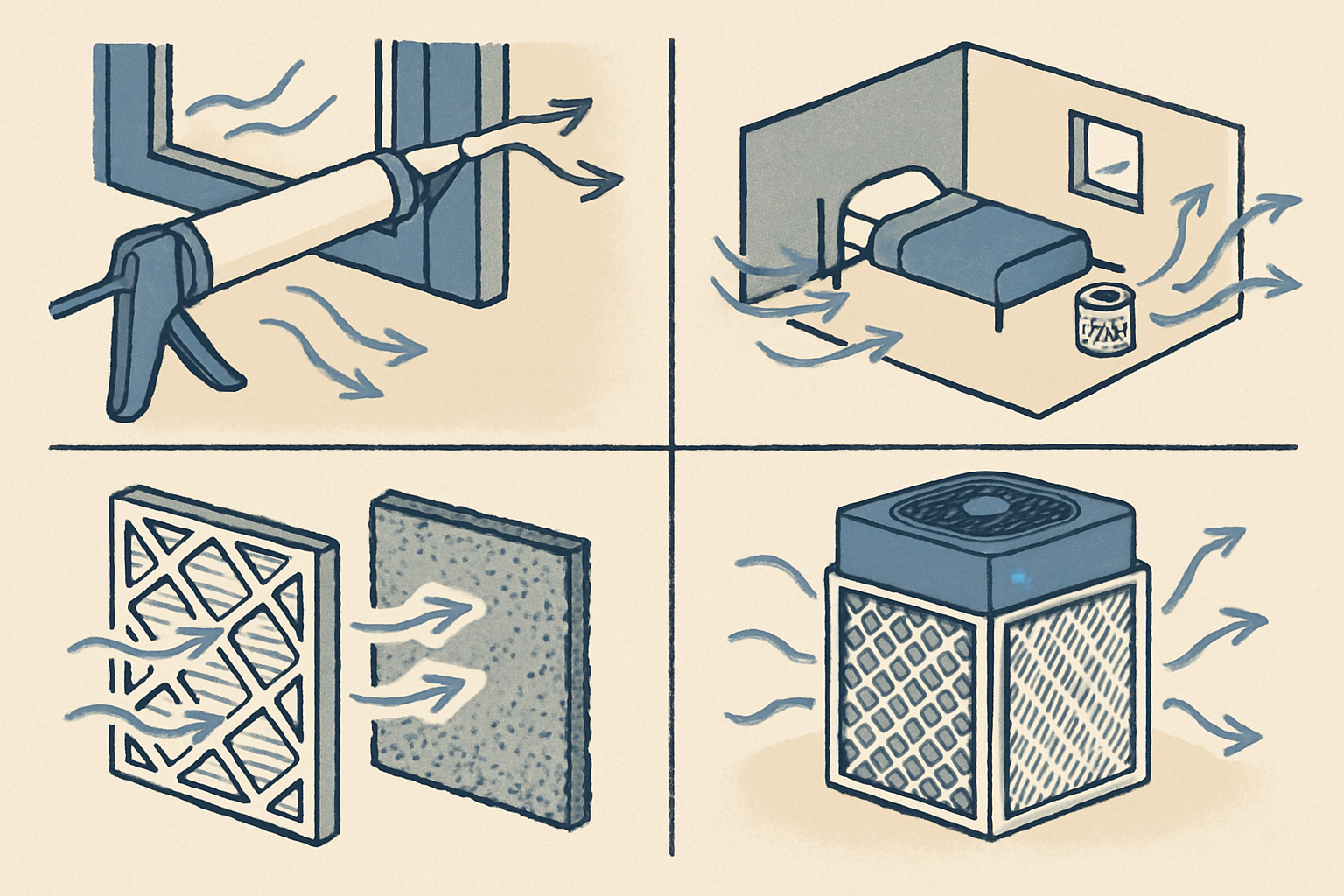
No air purifier performs well in a leaky house. Smoke particles are tiny — PM2.5 is 2.5 microns or smaller — and they slip through gaps that wouldn't bother a fly. Before you even think about filtration, spend twenty minutes identifying and plugging your biggest infiltration points.
The usual suspects: fireplace dampers (close them and tape a garbage bag over the opening if you haven't used the flue this season), mail slots, under-door gaps, and bathroom exhaust fan flaps that don't seal fully when off. Foam weatherstripping tape costs a few dollars at any hardware store and makes a real difference overnight.
Turn off whole-house fans and switch HVAC to recirculate
Whole-house fans pull massive volumes of outdoor air indoors — that's their job, and it's the last thing you want during a smoke event. Switch them off. If you run central air conditioning, check that the fresh-air intake damper is closed and set the system to recirculate indoor air only. While you're at it, upgrade your HVAC filter to a MERV 13 if it isn't already. MERV 13 captures a meaningful portion of fine particles on each pass through the system, and it costs maybe $15 more than a standard filter.
Step two: Understand what your air purifier can (and can't) do
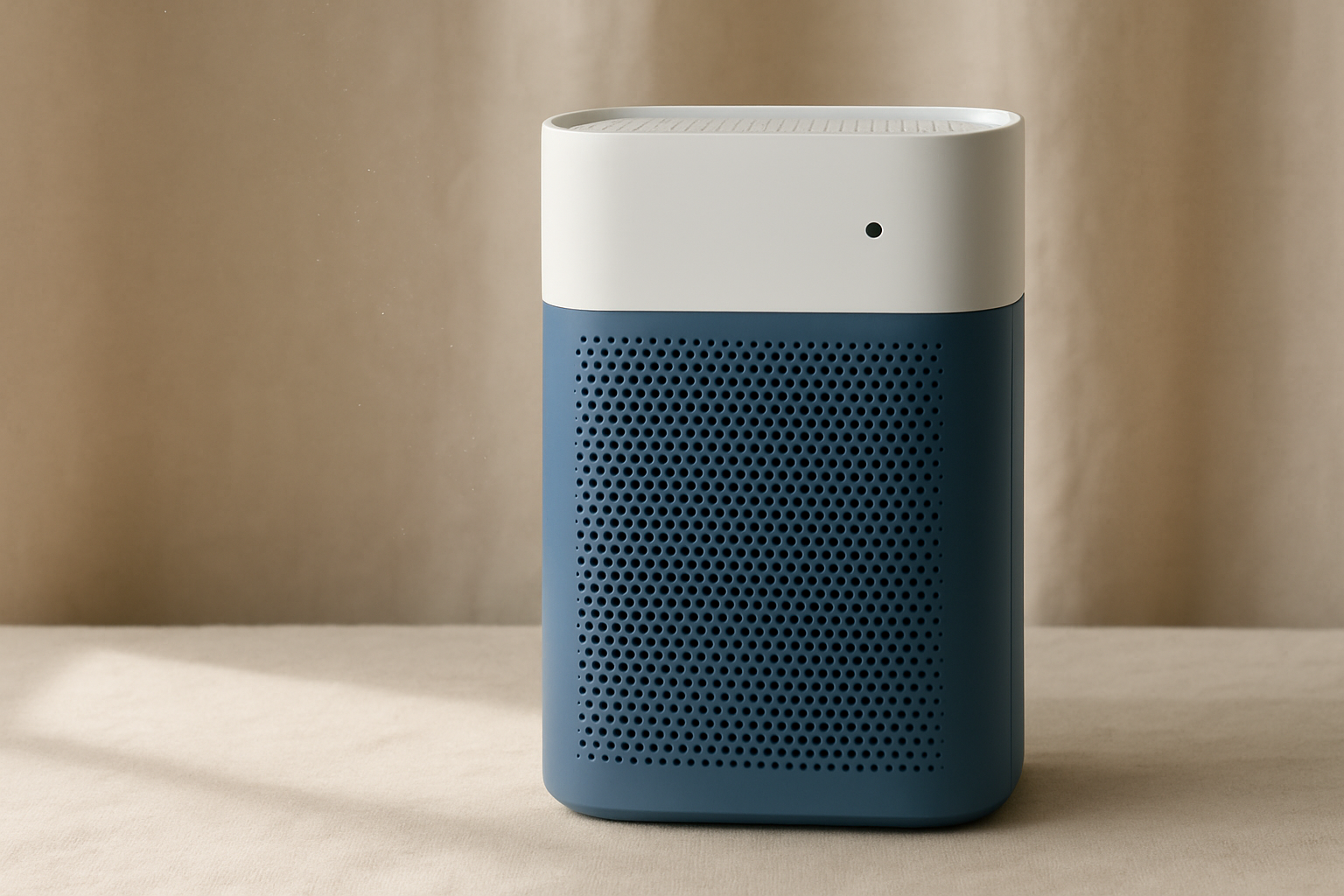
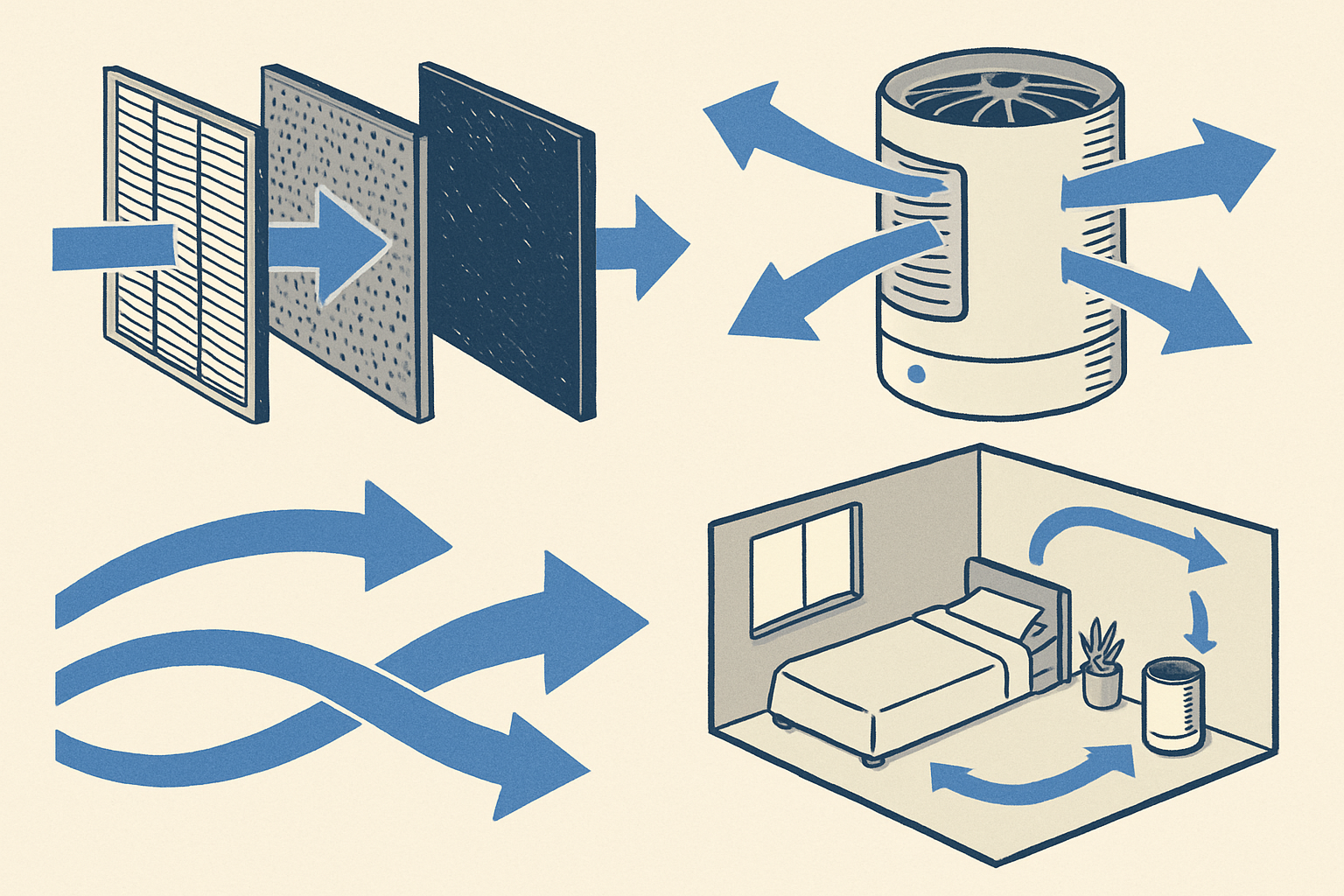
A True HEPA air purifier rated for your room size, running continuously on medium-to-high, will significantly reduce indoor PM2.5 — the manufacturer-rated CADR numbers give you a starting point for how much air the unit can clean per minute. But those ratings assume a reasonably sealed room. In a leaky space during active smoke infiltration, even a strong unit is fighting uphill.
The other thing to understand: HEPA captures particles, but it doesn't do much for the gases and VOCs that accompany wildfire smoke — the stuff that makes your eyes sting and leaves that campfire smell in your furniture. For that, you need activated carbon, and most budget purifiers include only a thin carbon pre-filter that saturates quickly. During a serious smoke event, a unit with a deeper carbon bed — at least a pound or two of granular activated carbon — makes a noticeable difference in odor and gas-phase reduction.
The Corsi-Rosenthal box: a serious DIY option
If you don't own a dedicated air purifier, or you need to cover a large room on short notice, the Corsi-Rosenthal box is worth knowing about. It's a cube of four MERV 13 furnace filters taped together around a standard box fan, with a fifth filter or a piece of cardboard on top. Total cost: roughly $50–$80 depending on fan and filter prices in your area.
The math behind it is straightforward. A 20×20 box fan moves around 2,000 CFM at its rated speed. With four 20×20×1 MERV 13 filters, you're pushing a large volume of air through a reasonably efficient filter medium. The face area of four filters dramatically reduces the pressure drop compared to a single filter on the fan face, which means the fan doesn't stall and you maintain real airflow.
It's loud. It's ugly. It works. Multiple indoor air quality researchers have run their own versions of this during wildfire events and found PM2.5 reductions in the range of what a similarly-priced commercial unit would achieve. For a living room or an open-plan space where a regular purifier would be undersized, it's a practical stopgap.
How to size a Corsi-Rosenthal box for your room
Target five air changes per hour (ACH) during a wildfire event. Multiply your room's square footage by ceiling height to get cubic feet, then divide by 12 to get the CFM you need. A 400 sq ft room with 8-foot ceilings is 3,200 cubic feet — you need about 267 CFM at five ACH. A single Corsi-Rosenthal box fan running on medium easily covers that, even accounting for filter resistance.
Layering your filtration strategy by room
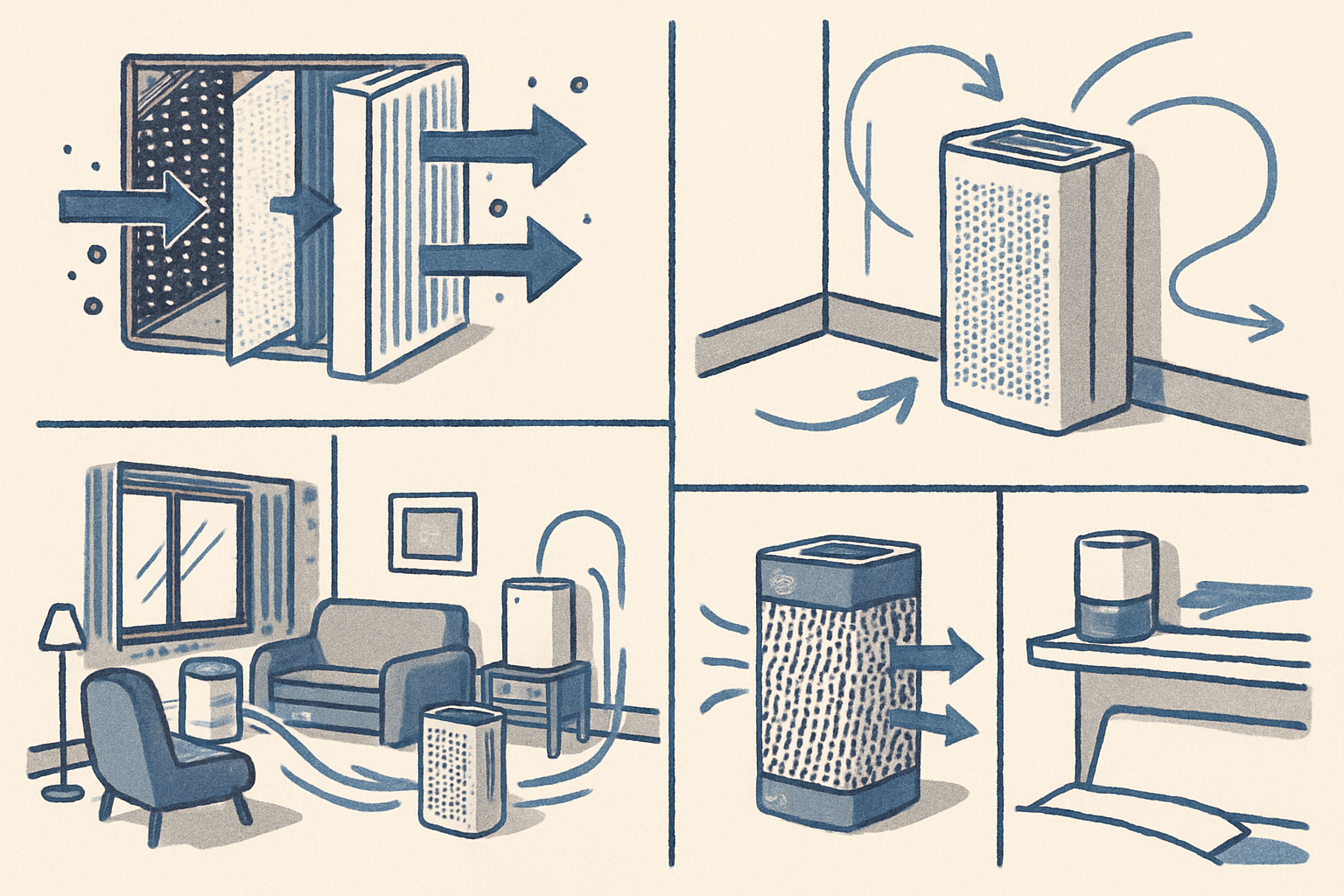
You don't need to clean your entire home to the same standard during a smoke event. The practical approach is to designate one or two rooms as "clean rooms" — typically a bedroom and, if possible, a main living area — and concentrate your filtration there.
- Bedroom: Keep the door closed. Run a True HEPA purifier continuously, even on sleep mode overnight. A unit rated for 1.5–2× your bedroom's actual square footage gives you a buffer for imperfect sealing.
- Living room/kitchen: This is where cooking and people traffic adds its own particle load on top of wildfire smoke. A larger unit here, or a Corsi-Rosenthal box if the room is open-plan, handles the higher load. Run the range hood when cooking to exhaust combustion particles before they spread.
- Everywhere else: Keep doors closed. The MERV 13 HVAC filter does the work for hallways and rooms you're not actively occupying.
Quick check: is your purifier actually keeping up?
A $30 laser particle counter (available on Amazon) tells you in real time whether your indoor PM2.5 is actually dropping. It's the single most useful tool I've added to my smoke-season setup. When the number stays stubbornly high despite the purifier running, it almost always traces back to an infiltration point I missed — not an undersized unit.
Filter maintenance during smoke season
A HEPA filter loaded with smoke particles is less effective than a fresh one — and during an extended wildfire event, a filter can accumulate weeks' worth of normal particle load in a few days. Check your pre-filter weekly during smoke season. If it's visibly gray or brown, replace or clean it (if washable) so the HEPA element isn't working harder than it needs to. Have a spare main filter on hand before smoke season starts. Shipping times get long once everyone in your region is ordering replacement filters at the same time.
The bottom line
Clean indoor air during wildfire season is achievable, but it requires thinking in layers: seal first, filter second, and prioritize the rooms where you spend the most time. A good air purifier is a meaningful part of that strategy — but it can't carry the whole load on its own. Pair it with a sealed envelope, a MERV 13 HVAC filter, and a clear sense of which rooms you're actually trying to protect, and you'll be in a much better position than most of your neighbors when the AQI climbs.
See our independently-assessed air purifier rankings
Every unit on Air Purifiers Tested is evaluated against published criteria by reviewers who've lived with the products. No brand pays for placement.
Browse All Reviews→